09 November 2017
Christmas facts and surveys
The Religious Celebration of Christmas
2.6 million people attended Church of England churches at Christmas 2016 (of whom 34 per cent received communion). During Advent, 2.5 million people attended special services for the congregation and local community, and 2.8 million people attended special services for civic organisations and schools. All figures showed an increase on the figures for 2015.
Reported total Christmas attendance in cathedrals was 131,000 in 2016, the highest figure since 2011. Total attendance increased 5% from 125,000 in 2015 and 1% from 130,000 in 2006. Services during Advent, the period leading up to Christmas, had a reported attendance of 635,000 in 2016, an increase of 2% from 624,000 in 2015.
https://churchofengland.org/media/4038454/2016statisticsformission.pdf
https://www.churchofengland.org/media/4043119/cathedral-statistics-2016.pdf
What do Christians thinks about Christmas?
In a survey conducted by the Evangelical Alliance in 2016 we found:
- 39 per cent of evangelicals surveyed will either provide food parcels for people in the community or meals for homeless or vulnerable people.
- 99 per cent of evangelicals surveyed will take part in a religious activity this Christmas (carol service, church on Christmas Day or Eve, or public carol singing).
- 94 per cent will take part in a carol service.
- 89 per cent of evangelicals surveyed will either volunteer or give money to a charitable cause this Christmas.
- 73 per cent of evangelicals surveyed will give to charity, and 22 per cent will give money to local, national and international charities.
- 99 per cent give consistently throughout the year or increase their giving at Christmas.
- 84 per cent of evangelicals surveyed characterise the celebration of Christmas in the UK as too much about money and consumerism.
- Two thirds (66 per cent) see Christmas in the UK as still a celebration of Jesus' birth, and an equal number view it as a great opportunity to tell people about Jesus.
- When asked personally about their enjoyment of various aspects of Christmas, Jesus came out top. 93 per cent scored celebrating his birth highly. 84 per cent highly enjoyed spending time with family and friends, 76 per cent giving presents, 35 receiving presents, and only 19 percent rated eating indulgently highly.
Why do occasional churchgoers go to church at Christmas?
In an essay entitled How far is Bethlehem? exploring the ordinary theology of occasional churchgoers by David Walker, the results of surveys of attenders at services in Worcester and Lichfield cathedral were published. Here are some of his findings:
Motivation for going to the service
- 94 per cent said their motivation was the music.
- 75 per cent said they wanted to be reminded of the Christmas story.
- 55 per cent said they wanted to feel close to God.
- 55 per cent said they wanted to worship God.
- 52 per cent said they wanted to find the true meaning of Christmas
What kind of service?
- 78 per cent said they prefer the service to be candlelit.
- 76 per cent said they prefer traditional rather than modern hymns.
- 94 per cent said they expected the service to be uplifting.
Belief in the Christmas story among occasional churchgoers
- 58 per cent believed in the birth took place in a stable
- 57 per cent believe in the role of the shepherds
- 55 per cent in the wise men
- 42 per cent in the virgin birth.
Reported on www.brin.ac.uk on 12 June 2013
The essay by Dave Walker is published in a collection of essays entitled Ordinary Theology: Everyday Christian believing and the Church edited by Jeff Astley and Leslie Francis published by Ashgate 2013.
Christian resources for churches and schools
The Evangelical Alliance information and research office has prepared a list of resources to help you plan a special service, talk or school assembly. The listing also includes sources for alternative gift solutions here.
Modern Celebration of Christmas
Belief in the Christmas story
In a survey done by YouGov in 2014 they found more than around 50 per cent of people don't believe the following aspects of the Christmas story:
- An angel of the Lord appeared to shepherds to announce the birth of Jesus (51% don't believe it, 20% don't know and 28% do believe it)
- Wise men were guided by a star and bought Jesus gold, frankincense and myrrh (44% don't believe it, 19% don't know and 37% do believe it)
- The newborn baby Jesus was laid in a manger (47% don't believe it, 24% don't know and 29% believe it)
Internet shopping on Christmas day - a popular activity?
Shopping on Christmas day has been a popular activity. In 2015 record numbers were expected to spend “a significant proportion” of their Christmas day shopping online, spending an estimated £728m, up 11 per cent on the £658m spent in 2014.
Reported in The Independent 25 December 2015.
Spending predictions for Christmas 2017
- Data compiled by price comparison site GoCompare, shows that 31 per cent of households plan to browse in the 2017 Black Friday sales which have for the last few years been the big start to the UK’s Christmas shopping period. It is estimated that £3 billion will spent during the event with 49 per cent of the shopping being done online. 23 per cent of shoppers planning to make Black Friday purchases wil use their credit cards to fund their purchases.
- In a survey for finance website Bobatoo 45 per cent said they don’t set a budget for their Christmas spending and 21 per cent said they will go over their budget. 34 per cent say they will stick to their budget.
- Bobatoo also asked how much people were planning to spend this year. Most people said they were planning to spend less than £200 on food, drink and decorations. Planned spending on presents is higher with 38 per cent planning to spend less than £300 and 30 per cent planning to spend £300-£500
Food, drink and gifts going to waste
In 2014 4.2 million Christmas dinners were wasted across the United Kingdom, according to Unilever. The figure is the equivalent to 263,000 turkeys; 7.5 million mince pies; 740,000 slices of Christmas pudding; 17.2 million Brussels sprouts; 11.9 million carrots and 11.3 million roast potatoes.
Reported in The Independent 4 December 2015
In research conducted for Christian Aid in November 2017 found that 50% of British families say they spend too much on food for Christmas which then gets thrown away. Sprouts and cranberry sauce are the items most likely to be thrown away with families in the West Midlands families being the most likely to throw away sprouts! More detailed statistics are available from the Comres website: http://eauk.co/2iAzXPO and to go along with the research Christian Aid have produced a short film highlighting food waste at Christmas time http://eauk.co/2iAhTFg
ING the financial services company found in their survey Christmas survey that around one in seven Europeans were unhappy wuth what they received for Christmas the previous year and 10 per cent couldn't even remember their gifts.
Although more than half said they had kept their unwanted gifts, 25 per cent 're-gifted' them to someone else. A further 14 per cent sold the items and 10 per cent tried to return them to the store. Five per cent even said they had given them back to the giver, with the British and Dutch being the most likely to do so (11 and 9 per cent respectively).
http://eauk.co/2zsWAiF
Charity shops also do well in January with the number of unwanted gifts being donated to them, the Post Office found in their research that 25 per cent of unwanted gifts end up being taken to charity shops.
Reported in Daily Telegraph online 26 December 2014
Knowledge of the Nativity story
In a survey of parents and their children undertaken by ICM for the Bible Society in December 2012, 22 per cent of parents and 18 per cent scored eight out of 10 in a Nativity knowledge quiz:
- 98 per cent knew Jesus was born in Bethlehem (Luke 2:4)
- 89 per cent knew Mary put the baby Jesus in a manger (Luke 2:7)
- 83 per cent knew the angel Gabriel told Mary she would give birth (Luke 1:26)
- 77 per cent knew Herod was king at the time (Matthew 2:1)
- 63 per cent knew the angels were the first to announce the news (Luke 2:15)
- 52 per cent knew Mary and Joseph were travelling because they has been ordered to register with the authorities (Luke 2:1)
- 46 per cent knew the shepherds were first to visit Jesus (Luke 2:16)
- 32 per cent knew the word emmanuel (Matthew 1:23) means 'God is with us'
- 26 per cent knew Mary and Joseph were engaged when she found out she was going to have a baby (Matthew 1:18)
- 14 per cent knew the wise men travelled west following the star to Jerusalem (Matthew 2:1)
Source: http://www.biblesociety.org.uk/news/children-and-parents-6-out-of-10-score-on-nativity-knowledge/
8% knew Jesus was born in Bethlehem (Luke 2 4)
2. 89% knew Mary put the baby Jesus in a manger (Luke 2 7)
3. 83% knew the Angel Gabriel told Mary she would give birth (Luke 1 26)
4. 77% knew Herod was king at the time (Matthew 2 1)
5. 63% knew the angels were the first to announce the news (Luke 2 15)
6. 52% knew Mary and Joseph were travelling because they has been ordered to register with the authorities (Luke 2 1)
7. 46% knew the shepherds were first to visit Jesus (Luke 2 16)
8. 32% knew the word Immanuel (Matthew 1 23) means 'God is with us'
9. 26% knew Mary and Joseph were engaged when she found out she was going to have a baby (Matthew 1 18)
10. 14% knew the wise men travelled West following the star to Jerusalem (Matthew 2 1)
- See more at: http://www.biblesociety.org.uk/news/children-and-parents-6-out-of-10-score-on-nativity-knowledge/#sthash.kly7p54x.dpuf
On average parents and children scored 6 out of 10. 22% of parents and 18% of children scored 8 out of 10 or more.
Just over half the families (52%) planned to go to a school nativity this year.
According to the survey, these are the ten best-known facts about the nativity:
1. 98% knew Jesus was born in Bethlehem (Luke 2 4)
2. 89% knew Mary put the baby Jesus in a manger (Luke 2 7)
3. 83% knew the Angel Gabriel told Mary she would give birth (Luke 1 26)
4. 77% knew Herod was king at the time (Matthew 2 1)
5. 63% knew the angels were the first to announce the news (Luke 2 15)
6. 52% knew Mary and Joseph were travelling because they has been ordered to register with the authorities (Luke 2 1)
7. 46% knew the shepherds were first to visit Jesus (Luke 2 16)
8. 32% knew the word Immanuel (Matthew 1 23) means 'God is with us'
9. 26% knew Mary and Joseph were engaged when she found out she was going to have a baby (Matthew 1 18)
10. 14% knew the wise men travelled West following the star to Jerusalem (Matthew 2 1)
- See more at: http://www.biblesociety.org.uk/news/children-and-parents-6-out-of-10-score-on-nativity-knowledge/#sthash.kly7p54x.dpufOn average parents and children scored 6 out of 10. 22% of parents and 18% of children scored 8 out of 10 or more.
Just over half the families (52%) planned to go to a school nativity this year.
According to the survey, these are the ten best-known facts about the nativity:
1. 98% knew Jesus was born in Bethlehem (Luke 2 4)
2. 89% knew Mary put the baby Jesus in a manger (Luke 2 7)
3. 83% knew the Angel Gabriel told Mary she would give birth (Luke 1 26)
4. 77% knew Herod was king at the time (Matthew 2 1)
5. 63% knew the angels were the first to announce the news (Luke 2 15)
6. 52% knew Mary and Joseph were travelling because they has been ordered to register with the authorities (Luke 2 1)
7. 46% knew the shepherds were first to visit Jesus (Luke 2 16)
8. 32% knew the word Immanuel (Matthew 1 23) means 'God is with us'
9. 26% knew Mary and Joseph were engaged when she found out she was going to have a baby (Matthew 1 18)
10. 14% knew the wise men travelled West following the star to Jerusalem (Matthew 2 1)
- See more at: http://www.biblesociety.org.uk/news/children-and-parents-6-out-of-10-score-on-nativity-knowledge/#sthash.kly7p54x.dpufWhat does Christmas mean to people and how will they be celebrating?
In a survey conducted by ComRes on behalf of Theos in December 2010 the following results were obtained:
- 51 per cent agreed with the statement "the birth of Jesus is irrelevant to my Christmas", while 46 per cent disagreed with the statement.
- 18 per cent agreed with the statement "I dread Christmas", while 81 per cent disagreed only 13 per cent agreed with the statement "I would borrow money to ensure I could afford to buy decent Christmas presents" - 86 per cent disagreed with the statement.
- 54 per cent agreed "Christmas is over-rated", while 44 per cent disagreed with the statement.
- 61 per cent agreed "Christmas is mainly for children", while 38 per cent disagreed.
- 36 per cent said they would be attending a Christmas service. 62 per cent said they would not be going to a service and two per cent were unsure.
Christmas cards, Christmas trees, Christmas Lights and Christmas carols
Christmas Carols
The largest group of carol singers, according to the Guiness Book of Records, gathered in Nigeria in 2014. 25,272 from Godswill Akpabio Unity Choir sang Joy to the world, Oh come all ye faithfull, Oh Christmas tree, Hark the herald sing, Once in Royal David's City and The first noel.
Christmas Trees
The tradition of displaying and decorating at tree at Christmas originates from Europe with records of trees decorated with sweets at guild halls in Germany and Livonia (Latvia and Estonia) in the 15th century. It's origins probably go back even further however with "paradise trees" decorated with apples being used in the medieval mystery plays that told the story of Adam and Eve that were performed on 24th December a possible fore-runner. Trees or evergreen decorations used as symbols of eternal life or protection from evil were also common in some parts pre-Christian Europe.
According to the Forrestry Commission 90% of British families put up a Christmas tree.
The British Christmas Tree Growers Association say their members sell eight million real Christmas trees every year.
The largest artificial Christmas tree measured 72.1 m (236ft 6.58 in) tall, and was made for Arjuna Ranatunga Social Services (Sri Lanka), in Colombo, Sri Lanka, on 24 December 2016.
The Christmas tree was built as part of a three-day carnival in the Gelle Face Green in Colombo.
http://eauk.co/2Ao7J1A
The most expensively decorated Christmas tree was on display in 2011 in Abu Dhabi it was 43 feet high and was covered in 181 items of jewellery valued at £6,975,880.
http://eauk.co/1HEIRzq
Christmas cards
The sale of single Christmas cards account for 12 per cent of the total retail value of the UK market. In addition 900 million boxed cards, worth £2billion are sent each year.
http://eauk.co/1SFp35t
Charity Christmas cards
Charities in the UK receive an estimated £50 million from Christmas card sales. We have compiled a list of some suppliers of Christmas cards with Bible verses or a Christian theme for our Christmas resources page.
Christmas Lights
The world's largest Christmas lights display has been switched on in a shopping centre in Australia for the 2014 Christmas season. The display features 1.2 million LED lights and has been created to raise funds for a children's charity, the electricity the lights are using is being donated by the power company.
http://www.bbc.co.uk/newsround/30242088
No room for Christ on Christmas cards?
In research conduct for Bible Society in 2012 Neilson found out of 6,000 types of Christmas cards on sale that year in shops on 34 had nativity related scenes.
Source Daily Telegraph
The first Christmas card
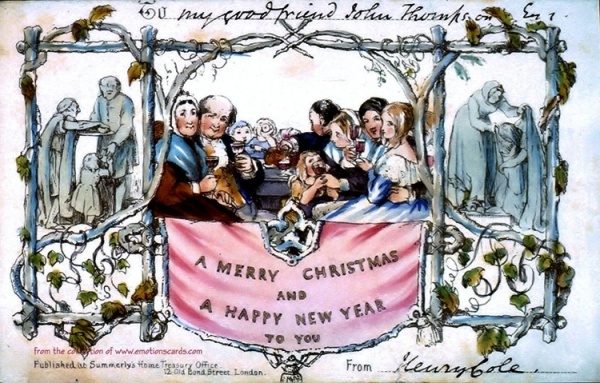
The first commercial Christmas card was commissioned by Henry Cole in 1843. He ordered 1,000 copies of the card designed by John C Horsley which depict a family enjoying a festive drink together. Religious greetings cards came some years later. The cards were advertised for sale in the Athenaeum newspaper and cost six pennies each thus making them a very expensive luxury item. The card was described in the advert as 'Just published. A Christmas Congratulation Card: or picture emblematical of Old English Festivity to Perpetuate kind recollections between Dear Friends.' www.postalheritage.org.uk
Three of the remaining 18 cards from the first batch produced by Henry Cole were auctioned by Sotheby's in New York In December 2011. One card was sold for $10,500, another one sold for $4,250 and the card bearing the design pictured below sold for $7,000.
http://bit.ly/HfTRVj