
01 July 2010
A radically new way to fight poverty
Ten years ago, the world's rich made a promise to the poor. Rev Joel Edwards, international director of Micah Challenge, urges us to take action...
Ratified by 192 nations in September 2000, the Millennium Development Goals represented how more and less developed nations could act in one generation to halve extreme poverty. With five years to go until the 2015 deadline, and with time running out fast, this might be the time for a radically different approach.
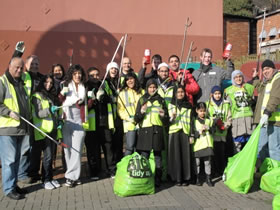
It was a crisp, clear February morning, as a fresh dusting of frost threatened to spoil the day's big plans. A group of young people (pictured) in the city of Leicester had assembled that morning to make a difference in their own community. Fighting a million deaths every year was their motivation, and a community-wide street tidy-up their medium of change.
As the community leaders, local residents and young people continued to arrive, one thing was different: this event to raise money for malaria was being run by a multi-faith group of young people - different religious groups working together.
 "I was hesitant about taking a post in the inter-faith arena," says Michael Tweed of the Tony Blair Faith Foundation. "Having been motivated to work for justice with my Christian brothers and sisters, I didn't wish to sell out or water down my own faith to work with those who believed different things to myself. But I am now one of 30 global Faiths Act Fellows, spearheading multi-faith work against malaria."
Ambassadors for Christ
Indeed, to consider operating in partnership with those of different beliefs has authenticity only when we remain ambassadors for Christ and consider how we can legitimately act together.
So what can we achieve together because of our faith rather than in spite of it? It is our faith that informs and mobilises us to a generosity that can reach over barriers, allowing us to become world citizens for the common good.
Examining the ministry of Jesus, we see a man prepared to engage with a Samaritan woman (John 4) and to reach out to Roman centurions. This idea of multi-faith action is not any kind of theological shift; the early Church always operated in a multi-faith context, as it never had the luxury of a mono-culture.
Multi-faith action happens on the ground in Africa already. In the fight against malaria, aid agencies search for the best way to get life-saving bedding nets to isolated communities where there are no hospitals, schools or infrastructure. They found that it was the faith communities that were often the most effective in caring for their local villages, had the networks to engage, and had the compassion to make a sustainable difference. This has meant that churches and mosques are working together.
When Michael attended the Interfaith Jubilee Debt Conference in Birmingham this March, he was surprised to find out that I, the Alliance's former general director, was the headline speaker. "I was taken aback at seeing a prominent evangelical leader engaging with those of other faiths," Michael says. "But this is a call to justice that is prophetic rather than merely political. Holding leaders to account and speaking up for the poor is integral to this work."
Demonstrating respect
 Multi-faith witness is a crucial part of our 21st century outreach, for it demonstrates respect for the values by which our fellow citizens live their lives and the common values that people of faith share. As an evangelical leader this has been an indispensible part of my ministry. However, nothing we do in multi-faith partnerships sets aside our views about the uniqueness of Jesus or the monotheism of our Judeo-Christian heritage.
How we see multi-faith work often depends on our own preconceptions. But for topics so central to the Christian Gospel as feeding the hungry and rescuing those in poverty, it is crucial that we act with those who will help us achieve our goals.
This is grassroots action in the United Kingdom, as well as on the ground overseas. With merely five years until the deadline, now is the time for urgency; multi-faith action may be our only godly choice. What we mustn't do is avoid multi-faith collaboration with the concern of not gaining credit for our Christian contribution.
We are commanded to "act justly, love mercy and walk humbly" (Micah 6.8), so our priority must be for those in need, however best they are served, rather than scoring points across faith lines.
Properly understood, multi-faith work is part of our mission responsibility in the 21st century. This is especially urgent in our global struggle against the degrading and dehumanising poverty that grips more than a billion people in our world. If as people of faith we're not up to managing our theological distinctive to allow us to work for the poor, then who will do it?
For more information, visit: micahchallenge.org.uk or tonyblairfaithfoundation.org
You might also be interested in
- 14 Aug 2018 Lighting up the darkness with Compassion UK