
01 July 2008
Returning to Narnia
Prince Caspian, the second film from CS Lewis' Chronicles of Narnia, is already one of the biggest blockbusters of the year. Rich Cline meets the person responsible for maintaining Lewis' singular vision…
Many of us first experienced the Narnia stories as children, and have continued to rediscover them, unearthing new themes as we've grown up. The seven distinctly different books have Christian themes woven into them in unexpected, even provocative ways.
So when Hollywood set out to make big budget movies out of the books, we worried that they would water down CS Lewis' depth and meaning. But they didn't. In 2005, The Lion, the Witch and the Wardrobe was a massive hit, raking in nearly £400m at the worldwide box office.
So expectations have been high for this summer's Prince Caspian, which has an even more complicated and challenging message.
So who is helping the film studio get this right? It turns out that the CS Lewis legacy lies on the shoulders of one man. And it would be impossible to find someone more appropriate than Douglas Gresham, Lewis' stepson, whom he adopted with his older brother David in 1956. Lewis wrote the Narnia stories for his stepsons between 1949 and 1954. So while we may have grown up with the stories, the Gresham boys grew up in them.
I met Gresham in London on a late-spring afternoon. He was dressed all in white, with knee-high riding boots and a spark of youthful energy that belies his 62 years. You could imagine him with a racing cap and goggles, zooming along the Corniche in a souped-up roadster. And indeed, he did just that earlier this year as part of a sponsored road trip from Somerset to Malta, where he lives with his wife Merrie.
"There isn't really a Hollywood credit to describe what I do," says Gresham, who is listed as a co-producer on Prince Caspian and has a cameo as a town crier. "It's my job to make sure that they get it right. Every script that's done, whether it's a ballet, stage play, radio play, video game, whatever, comes across my desk. And I'm also in charge of overseeing all of the merchandise and marketing. I'm probably the only person in the world qualified to do what I do, so it's unlikely I'll become redundant."
He also feels fortunate that the director of both films, Andrew Adamson, understands where he's coming from. "Andrew was brought up in the forests of Papua New Guinea by missionary parents," he says. "While he may not be a card-carrying Christian, he has a full understanding of what I'm trying to do. We've never had a head-to-head fight about anything."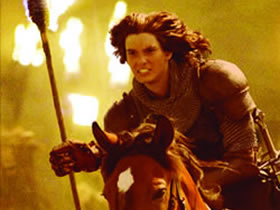
Delight and wonder
Growing up with CS Lewis, or Jack as he was known, was a huge privilege. "It was a time of great sorrow, torment, difficulty and fear," he says, referring to his mother Joy's death from cancer and Lewis' death three years later, "and yet it was shot through all the time with delight, wonder and joy. And I loved having the experience of growing up in Narnia. We considered fawns, centaurs and all of these characters a normal part of our life. I still do."
But it's Lewis' profound faith that made the biggest impact on his life. "The first thing to realise about Jack himself is that he lived his faith," he says. "He not only believed in Jesus; he believed Jesus. And when Jesus said, 'This is how you should behave,' Jack took it to heart and put it into practice more than any other man I've ever met. So I was constantly seeing examples of how a Christian should live and think and talk. I'm not very good at it, but Jack was very good at it.
"For example, he was once walking with a friend in Oxford, and a beggar in the street approached him, asking if he had any spare change. Jack immediately put his hand in his pocket, pulled out all of his change and put it in this man's hand. And as they walked off, this friend said, 'Jack, you shouldn't have given that man all that money. He'll only spend it on drink.' And Jack said, 'Well, if I had kept it, I would have only spent it on drink.'
"He was an amazing man in his Christianity, but at the same time, it didn't impinge on him any kind of dour 'Presbyterian' attitude. He was a great raconteur; you couldn't be in conversation with Jack for five or 10 minutes without roaring with laughter. He was terrific fun to be with, all the time, even when things were really tough. When my mother was lying, dying in her bed, she and Jack were swapping jokes. It was just extraordinary."
This exceptional ability to make the Gospel bracingly real is reflected throughout Lewis' books and his life. "He went to the local parish church because he felt it was his duty to do so," Gresham says. "Toward the end of his life he was coming closer to Christ, and that moved him further away from the church, which was interesting for me to watch."
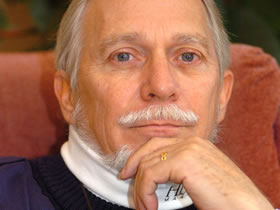 Lewis wrote the Chronicles of Narnia specifically to help young people avoid the pitfalls of society, Gresham says, and as they deal with the issues of the 1950s they're also relevant today. "Prince Caspian is all about a return to true faith, justice, honour, responsibility, social commitment and so forth," he says. "And I think actually it's more powerfully brought out in the movie than it is in the book. And I think Jack would be proud of what we've done with it."
A darker story
Gresham admits that the first film was naturally skewed to children, but stresses that this is a "darker story altogether", as it examines centuries of social decay, during which faith has been corrupted. The message is that there is a way for a society to return to true faith and justice. "One of the strongest messages that we see in the movie, and the book, is that no matter how far away we stray, there is always one way back, and it's up to us to find it," he says.
Plans are already underway to adapt the next two Narnia books - The Voyage of the Dawn Treader and The Silver Chair - for the big screen, and Gresham is also developing a film based on The Screwtape Letters. He'd also love to make movies from Lewis' Space Trilogy and the Greek myth Till We Have Faces.
He brushes off comparisons with other fantasy franchises, such as the Lord of the Rings movies ("Being a bit of a Tolkien purist, having been around Tolkien himself, I was both delighted and disappointed at the same time, so I'm trying to avoid that scenario with our movies"), Philip Pullman's His Dark Materials ("What he's written about Jack has shown me that he has completely misunderstood everything Jack ever wrote") and Harry Potter ("fluffy fun books for kids"). And he can afford to be this dismissive, since the Chronicles of Narnia books outsell all of them.
Although it took decades to get the Narnia movies made, Gresham never gave up. "And I'm quite convinced that the Holy Spirit of God inhibited my efforts to make these movies until such time as the technology had advanced in order that we could do the books justice," he says. "I think that was an important thing - the delaying time, which drove me nuts of course, but was necessary. And I'm pleased we did wait as long as we did, because look at what we've got on the screen now."
You might also be interested in
- 27 Jul 2018 Love Island, Hugh Grant, and Jesus: Who does it better?
- 13 Jul 2018 Southgate and Trump: leadership in an age of extremes
- 11 Jul 2018 Undivided: thoughts on Vicky Beeching’s new book
- 06 Jul 2018 Social media, trolling and unfollowing followers
- 27 Jun 2018 idea: Opportunity amid uncertainty