
01 May 2009
Talking about... Justice
Whether we are talking from a pulpit or over a garden fence, Tony Watkins helps us to give relevant answers to the big issues raised by contemporary popular culture…
Scientists have recently discovered that people's reaction to injustice is disgust. When people are treated unfairly in a game, their faces react in exactly the same way as when they taste something foul or see images of filthy toilets. According to the researchers, this suggests that, "not only do complex thoughts guide our moral compass, but also more primitive instincts related to avoiding potential toxins".
Is a sense of justice something innate in us, or is it something we learn? Every parent knows that children have a strong instinct for fairness. A child will be up in arms if someone else gets more than their fair share. Yet they never complain when they're the ones who benefit. They're quick to ensure that wrongdoers are dealt with, as long as the wrongdoer is somebody else.
So is it selfishness, then, which prompts young children to declare, "It's not fair!", rather than an inborn sense of justice? Surely it's both. The biblical view of human beings is that we are created in God's image and that we are also anti-God rebels. These two sides of our nature are in constant conflict. What comes out, then, is often a sense of injustice. We feel it deeply.
As children mature, they begin to develop empathy and learn to feel for the injustice that others experience. But adults are still often driven by the perception of being treated unjustly.
This is a key theme in countless current films. Good tells the story of John Halder (Viggo Mortensen), a mildmannered academic in pre-war Germany who objects to the Nazi party's encroaching power dictating what he can teach. For selfish reasons he nevertheless allows himself to be sucked in, while his closest friend Maurice (Jeremy Isaacs), a Jewish psychoanalyst, faces increasing injustice. This injustice is not just at the hands of the state, but is also a result of Halder's self-interest.
This idea also can be expressed as a conviction that someone must be brought to justice for the bad things they have done. This is what motivates the attack on senior Roman Catholic figures in Angels and Demons, which Robert Langdon (Tom Hanks) heroically attempts to unearth.
The issue of liberty
There's plenty of talk about justice within our society, but there are competing views on what it is. It's closely bound up with issues of liberty and rights.
For Austrian philosopher Friedrich von Hayek, who was a colossal influence on Margaret Thatcher, justice was all about liberty. The ultimate good is the freedom to do whatever you like on your own property, providing you don't interfere with the rights of others. So laws should be about preserving individual liberty, not bringing about social justice.
One problem with promoting individual freedom at the expense of social justice is that it easily results in marked inequalities. While our economy was doing well, we didn't give this too much thought. But now there's a widespread sense about the injustice of huge bonuses for bankers who presided over the disaster.
Another influential philosopher, John Rawls, argued that Hayek was wrong: justice comes before liberty, and must include the notion of equality. He believed that a just society guarantees more liberty for more people. Justice, which he saw in terms of fairness, is "the first virtue of social institutions, as truth is of systems of thought".
Rawls insisted that there is such a thing as social justice. Some people in society are disadvantaged and therefore lack freedom and self-respect. One of society's highest concerns should be to deal with this injustice. His thinking at this point reflects the Bible's deep concern for dispossessed, downtrodden and marginalised people.
Despite the rise of moral relativism over the last half-century, justice is still a central value in our society. We frequently talk about it in terms of human rights, seeing injustice as something that infringes those basic rights.
 This is a central idea in the X-men stories, including the latest film, X-men Origins: Wolverine. The mutants like Wolverine (Hugh Jackman) are constantly on the receiving end of prejudice, bigotry and hatred, raising the question of what their rights are and how they should respond when they are treated badly.
Commitment to justice
These issues have always been important in Star Trek too, especially in the early series when creator Gene Roddenberry saw each episode as a morality tale. The commitment to justice is still there in the new film, which goes back to the origins of the USS Enterprise crew and their first conflict with the Romulans who threaten the peaceful Federation.
Such stories resonate strongly because the issue of justice matters so much to us. We instinctively cry out for justice when we hear of a terrible crime being committed. We are rightly appalled at corruption because justice and truth are always its first casualties.
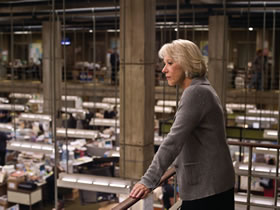
The political thriller State of Play has human casualties too, leading journalist Cal McCaffrey (Russell Crowe) into a web of intrigue, deception and danger. The tension of films like this comes not just from the hazards facing the hero, but from the question of whether there will finally be justice.
This is a big question in real life too. We feel this need for justice so deeply because it is innate: it is a vital aspect of being made in God's image. And we need to know that even when human justice fails, God's perfect justice will not.
- Find out more about the issues raised in this article at: damaris.org/ideamagazine
- Toolsfortalks.com contains quotes and illustrations taken from the latest films, music, magazines and TV - updated weekly.

- Photos - Top: Viggo Mortensen stars in the film Good as John Halder, a professor who loses his moral footing when he neglects to stand up against Nazi rule. © Lionsgate - Bottom: Helen Mirren plays a ruthless newspaper editor in State of Play, an American film based on the British TV series about political corruption and injustice. © Universal
Tony Watkins is managing editor of Culturewatch.org
You might also be interested in
- 01 Aug 2018 Remembrance 100: 100 days of prayer
- 08 Jun 2018 Grenfell Tower: how to love your neighbour
- 20 Apr 2018 The silence of the lambs
- 02 Mar 2018 An army of adolescents
- 02 Feb 2018 Justice and the sins of our youth