
Whenever the topic of Christian freedoms comes up in conversation, it seems widely accepted that it is getting significantly harder to be a Christian in the United Kingdom. This is often put down to changes in social attitudes towards Christians and more broadly people of faith, rather than any legislative changes that have occurred. But what do evangelicals really think?
Confident faith, contested culture reports on a recent survey from the Evangelical Alliance which sought to gain an understanding of how evangelicals live out their faith in public and the challenges that they face.
We asked 884 evangelicals in late 2025 about their personal freedoms as Christians, what it’s like engaging in public life, being a Christian in the workplace, and sharing faith. We also asked about their experiences of hate crimes and other hostilities as well as their views on Christian nationalism.

Commenting on the launch of the report, Danny Webster, director of advocacy for the Evangelical Alliance said: “Evangelicals in the UK have considerable freedom to practise their faith, and to practise it in public. Whether that’s meeting to worship without fear of reprisals, or preaching in the street, or talking about your beliefs at work, the freedom of Christians is real, meaningful and worthy of gratitude.
“And yet, there is a growing sense among many that the cultural context is changing and making things harder. While the legal protections are there, we found many evangelicals feel greater pressure, experience misunderstanding or marginalisation, and feel that there is less room for their beliefs in public life.”
- Most evangelicals feel free to live out their faith
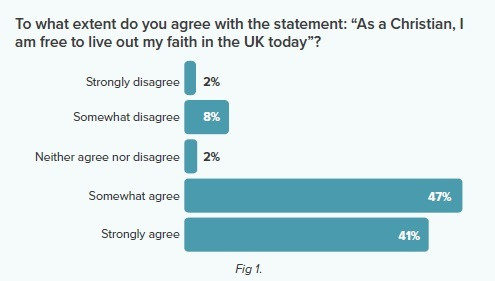
We asked evangelicals if they agreed with the statement; “As a Christian, I am free to live out my faith in the UK today”. 88% of respondents agreed, with 41% reporting that they strongly agreed. This is really encouraging news. We often forget that the United Kingdom is one of the freest places to be a Christian. There are very few restrictions placed on us by the state, and we’re rarely ostracised socially on account of our faith.
- Evangelicals are willing to take a stand
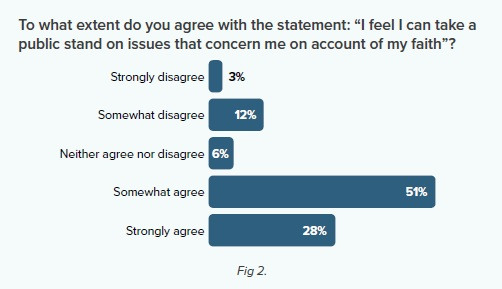
How confident are evangelicals in taking a stand on issues that would concern them due to their faith? There were encouraging results, but also signs that more work needs to be done. Overall, 79% of people agreed with the statement: “I feel I can take a public stand on issues that concern me on account of my faith”. However, a significant proportion (51%) reported that they ‘somewhat agreed’ with the statement. The local church has a role in encouraging and educating their congregations so they can take a stand on issues that concern both the church and wider society, even if they come at personal cost.
- Evangelicals disagree as to whether it has got harder over the past five years
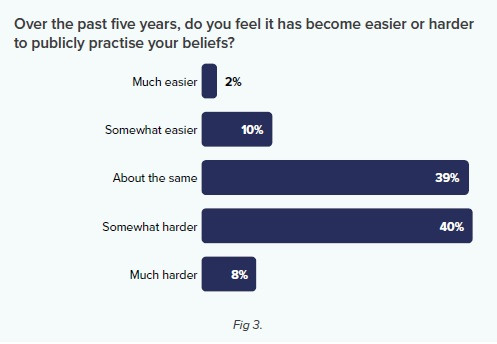
Interestingly, when we asked if over the last five years it had become easier or harder to publicly practise beliefs, there was significantly more uncertainty among evangelicals. About 40% of the respondents felt it had become somewhat harder, closely followed by 39% of evangelicals thinking that it hasn’t significantly changed over the past five years. As part of our questioning, we gave respondents an opportunity to expand. Those who felt it had become more difficult often reported that they had to talk with much greater sensitivity about a variety of key cultural issues, as well as the increasing levels of polarisation that we are finding in our politics and our churches.
- Hate crimes against Christians are rare, but many reported experiencing hostility
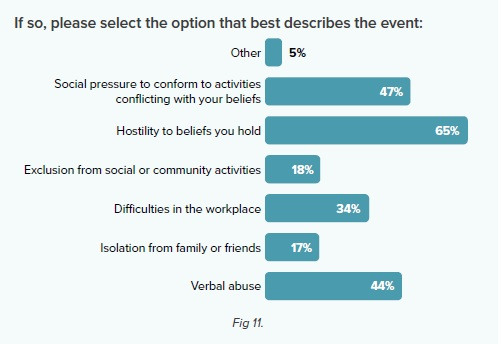
We also want to understand evangelical’s experiences with faith-based hate crimes and wider hostilities. The research indicates that there are few hate crimes occurring against Christians which is another positive indicator of the freedoms that we have. Unlike many of our brothers and sisters around the world, we can live free from persecution and harm on account of our faith.
However, when asked about non-hate crime hostilities, 35% of evangelicals said they had experienced this in some way. These ranged from social pressures to conform to experiencing verbal abuse. This shouldn’t dissuade us from expressing our faith but does serve as a reminder that our faith is counter-cultural, and we will have to make sacrifices.
- Evangelicals are concerned about the rise of Christian nationalism
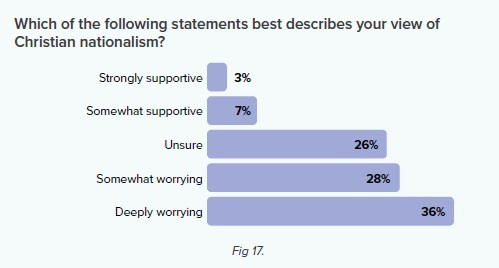
In the wake of events such as the ‘Unite the Kingdom’ march in September, the topic of Christianity’s place in the public square has been hotly debated. As a result, we sought to get a sense of evangelicals’ views on Christian nationalism. We asked how respondents would describe their view on Christian nationalism. Approximately 63% of evangelicals felt that Christian nationalism was worrying with a further roughly 26% unsure on their view. Despite the wide-ranging definitions of the term ‘Christian nationalism’, and uncertainty as to what exactly it’s referring to, this would suggest that evangelicals are cautious about conflating their identity in Christ with national identity
These findings in Confident faith, contest culture are a snapshot of the research, painting a complex picture of how we live out our faith in our everyday lives. We can take comfort in our freedom to practise our faith, while being challenged that there is more, we can do in proclaiming Jesus in the public square.

Confident faith, contested culture report
How are evangelicals living out their faith in the UK today?