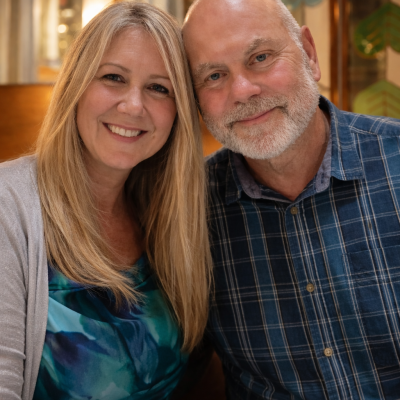

Ten years ago, I discovered that pornography had been part of my marriage. It came to light accidentally and unexpectedly, and the impact was immediate and deeply unsettling.
It felt as though the ground shifted beneath me. I wasn’t just reacting to what I had found. I was trying to make sense of what it meant. The marriage I thought I was in suddenly didn’t feel real.
That disorientation is something many couples are unprepared for. The impact is not only about the behaviour itself, but about what has been hidden, and what that does to the safety and trust. For many, this is where the language of betrayal begins to surface, because attention and intimacy that were meant to be held within the marriage have been directed elsewhere, in secret.

At the same time, my husband Jez was carrying something he had never spoken about. “I had lived with it for years,” he says. “It wasn’t just a habit; it had become an addiction. Something I didn’t want but didn’t know how to stop. And when it came out, the shame was immediate, but so was the quiet relief that something hidden was finally in the light.”
That combination of deep shame on one side and deep rupture on the other, creates a dynamic that is difficult to navigate without careful support.
In many Christian contexts, the response to something like this can unintentionally oversimplify what is happening, and at times place pressure on couples to resolve something that is not yet understood. There can be an emphasis on stopping the behaviour quickly, on repentance, and on accountability, all of which matter. But stopping a behaviour is not the same as restoring a marriage. As scripture reminds us, transformation is not surface-level. It is a process of being made new (Romans 12:2), not simply behaving differently.
Stopping a behaviour is not the same as restoring a marriage.”
In those early stages, what is often needed most is not resolution but stabilisation. This means putting boundaries in place, creating structure and beginning to understand what sits beneath the behaviour.
For Jez, this involved facing patterns that had begun long before our marriage. “It forced me to ask questions I’d avoided,” he says. “Where this started, what I was turning to it for, and why I couldn’t stop on my own.”
For me, the work looked different. One of my first thoughts was that I wasn’t enough. But over time, I began to realise that what I was feeling wasn’t simply insecurity – it was the impact of what had happened.
That clarity matters, because healing cannot begin if the impact is minimised. At the same time, responsibility cannot be removed from the one who has caused the rupture. What is needed is truth and love, held together rather than separated. Ephesians 4:15 reminds us to “speak the truth in love”. In situations like this, both are essential. Truth without love can crush. Love without truth can enable. Together, they create the conditions for something new to be built.
One of the most significant shifts for us was recognising that we couldn’t return to the marriage we had before. We had to build something different, and that process was neither quick nor linear. There were periods of progress, followed by setbacks. Moments of clarity alongside moments of deep discouragement.
We couldn’t return to the marriage we had before. We had to build something different.”
For Jez, healing required more than stopping. It required ongoing honesty, accountability and a willingness to bring everything before God. “Real change began when I stopped trying to manage it quietly,” he says, “and allowed God to deal with it properly – not just the behaviour but what was underneath it.”
Over time, we began to understand more clearly something of God’s character in this. He does not expose in order to shame but in order to restore. He is patient, truthful and committed to transformation at the level of the heart.
For me, healing involved rebuilding a sense of identity that had been shaken. I had placed more weight on the marriage than I realised. And when that broke, I had to come back to what was actually secure: who I am before God.
Hebrews 12:28 speaks of receiving “a kingdom that cannot be shaken”. That became an anchor. Because when everything else feels uncertain, faith cannot simply be a concept; it has to become something that holds.
Over time, something began to change. Trust was not restored through words but through consistent, repeated actions. Safety was not assumed but slowly rebuilt. And connection, real connection, began to form again.
Today, our marriage is not what it was before. It is stronger, with greater honesty, greater emotional awareness, and a deeper understanding of one another – both in how we relate and in how we live. We continue to revisit and strengthen what has been built, regularly taking ourselves back through the process that helped us rebuild in the first place – not because things are broken but because it keeps things healthy.
One of the reasons we now speak about this is because we have seen how many couples find themselves here, trying to resolve something that first needs to be understood. What is needed in those early stages is not pressure to move on quickly but clarity. Clarity about what has happened, what needs attention first and what can take time.
Galatians 6:9 reminds us not to grow weary in doing good, “for at the proper time we will reap a harvest if we do not give up”. For couples navigating this, that matters.
There is also an opportunity for churches to respond with greater understanding, to create space for honesty, and to support couples with patience rather than pressure. This is not a quick fix, but it is not without hope. With honesty, with structure and with a foundation that does not shift, it is possible to move forward – not by returning to what was before but by building something new and something more beautiful.